

There’s no absolute answer — nothing guarantees a “most beaten-down” sector will rebound strongly — but based on recent 2025 data, we can pinpoint sectors that have been hit hard this financial year and which many analysts view as possible long-term recovery candidates (7-year horizon or longer). Below I sketch (1) which sectors are most beaten-down recently, (2) why they might recover over medium to long term, and (3) factors you should watch.
📉 Sectors most “beaten down” in 2025 (short-term underperformers)
These sectors / mutual-fund categories have under-performed in 2025, often delivering negative returns — sometimes sharply — across many schemes.
-
Technology / IT-/services funds: As per a recent review, technology-sector funds have dropped by ~ 9% on average in 2025 so far.
-
Pharma & Healthcare sector funds: On average, these lost ~ 5–6% in 2025.
-
Small-cap and some mid-/flexi-cap funds: The small-cap space has suffered due to muted earnings and valuation fatigue; small-cap funds on average lost around 4.1% in 2025.
-
Sectoral/thematic funds broadly: Many sectoral/thematic funds (across themes) have posted sharp negative returns — up to 20-25% losses in 2025 for some schemes. Information are collected from The Economic Times.
Hence, broadly speaking, the most beaten-down sectors/themes are Tech/IT, Pharma/Healthcare, and Small-cap / broader risk-oriented funds + thematic/sectoral funds.
🔎 Which of these have potential to revive over next 5–7 years (and why)
While past under-performance doesn’t guarantee future gains, some of the beaten-down sectors may offer long-term “recovery + growth” potential. Here’s how:
– Technology / IT / Services
-
Why potential: The global technology landscape tends to be cyclical. After a slump — often due to valuation corrections, global macro headwinds, subdued enterprise-tech spending — there’s room for rebound as demand recovers, companies adapt, and valuations normalize. Even though 2025 saw downward pressure (global tech softness, weaker deal flows), over a 5–7 year horizon global digital transformation, AI-adoption, outsourcing demand etc. may bounce back.
-
What to watch: Global economic growth, demand from USA/Europe, currency volatility (USD/INR), valuations, Indian IT firms’ ability to adapt to changing tech demand.
– Pharma & Healthcare
-
Why potential: Healthcare and pharma are often less cyclical than sectors like consumer discretionary or tech — demand persists even in downturns. If valuation is depressed now, and global pricing/regulatory headwinds ease (esp. for generics, export markets), there’s scope for recovery. India’s population growth, rising healthcare spend, domestic demand, and export potential all support a long-term case.
-
What to watch: Regulatory environment (domestic & global), drug-pricing pressures, global demand, currency impact, R&D & product pipeline, domestic healthcare reforms.
– Small-cap / Mid-cap (Value / Recovery plays)
-
Why potential: Small-cap / mid-cap funds tend to be more volatile — which means bigger downside in tough years, but also bigger upside in a market recovery or when broader economic conditions improve. Over 7 years, many smaller companies may grow faster than large incumbents, if India’s economic growth, consumption, and corporate earnings pick up.
-
What to watch: Company fundamentals, quality of firms in the fund’s portfolio, management, economic growth, interest rates, valuations.
– Sectoral / Thematic funds (selectively)
-
Why potential (with caveats): Thematic or sectoral funds tend to be volatile but can reward patient investors if macro-economic or structural trends favor them. For instance, if a battered sector undergoes turnaround — via government policy support, economic cycle recovery, or demand revival — thematic funds may benefit.
-
What to watch: Picking the right theme (not chasing transient fads), diversification within theme, macroeconomic stability, regulatory or policy support (especially for sectors like infrastructure, healthcare, technology).
⚠️ Risks & What Could Go Wrong
-
Past underperformance doesn’t guarantee rebound — some sectors may remain muted if structural headwinds stay (global slowdowns, regulatory pressures, competition, currency risk).
-
Thematic/sectoral funds are riskier than diversified funds. Poor timing or wrong theme could result in permanent losses.
-
Small-cap and mid-cap funds remain volatile — returns may swing drastically. Requires a long-term horizon and stomach for volatility.
-
Market cycles are unpredictable — external/global macro events (global recession, commodity shocks, currency depreciation) can derail even fundamentally sound sectors.
🎯 My View: Which Sector(s) I Would Watch for a 7-Year Horizon (If I Were You)
If I were investing today with a 7-year horizon, I’d consider:
-
A mix of Tech/IT-oriented funds and Pharma/Healthcare funds, because diversification across cyclical (tech) + relatively defensive (healthcare) seems balanced.
-
Some small-cap/mid-cap value funds, especially those that invest in companies with solid fundamentals but undervalued now.
-
Possibly a small allocation to thematic/sectoral funds, but only after doing careful homework (theme viability over 7 years, fund holding quality, risks).
Well — here’s a starter list of mutual-fund schemes in India (as of late 2025) that many analysts / data-trackers consider reasonably good bets for long-term (5–10 year) investment — including some from sectors or categories that were under-pressure recently (hence possibly “discounted,” with room for rebound). Use this as a starting point, and check each fund’s holdings, your risk-tolerance, and time horizon before investing.
✅ Some mutual-fund schemes worth considering now (5–10 year horizon)
Small-Cap / Mid-Cap (High-growth + Recovery potential)
-
Quant Small Cap Fund — Among small-cap funds that historically generated high 5-year returns; though small-caps are volatile, this fund’s long-term growth potential is attractive.
-
Nippon India Small Cap Fund — Large AUM, relatively diversified small-cap portfolio; past 5-year CAGR has been strong, which might reward long-term investors willing to ride cycles.
-
Bandhan Small Cap Fund — Among top small-cap schemes over multi-year periods; could offer upside if Indian economy and small-cap companies recover well.
-
Tata Small Cap Fund — Lower expense ratio compared with many peers, which can benefit long-term compounding; though returns in recent 12 months have been weak, small-cap cycles tend to swing, offering potential upside.
-
Motilal Oswal Midcap Fund — Mid-cap tends to be less volatile than small-cap but with higher growth potential than large-cap; historically among better performing mid-cap funds.
Sectoral / Thematic — Pharma / Healthcare (Defensive + Long-Term Growth)
-
ICICI Prudential Pharma Healthcare and Diagnostics Fund — Among the top pharma/healthcare funds in 2025; decent 5-year returns, and pharma/healthcare tends to have relatively stable demand over long term.
-
SBI Healthcare Opportunities Fund — Good long-term performance among sectoral healthcare funds; a potentially less volatile way to get exposure to the healthcare sector.
-
DSP Healthcare Fund — Another decent healthcare-sector fund with competitive historical returns among peers.
Sectoral / Thematic — Technology (High-risk, High-reward, for aggressive long-term investors)
-
Invesco India Technology Fund — Has suffered in 2025 (along with many tech funds), which means valuation may be depressed; for a long horizon (7–10 years) and high risk-tolerance, this could be rebounding opportunity if global tech demand/outsourcing improves.
-
(Alternatively, if you want lower volatility than pure tech-sector funds, you might consider balancing with mid-cap/small-cap or sector-diversified funds above.)
🔎 Some important thoughts or you can say caveats before you pick
-
Risk & Volatility: Small-cap and sectoral funds (especially tech) are volatile — downturns are sharper, but long-term returns can also be strong if you stay invested through cycles.
-
Diversification matters: Instead of putting all money into one fund, diversify across categories (small-cap, mid-cap, sector-funds, maybe large-cap or index funds) to manage risk.
-
Time horizon: These funds make sense only if you are ready to remain invested for at least 5–7 years (preferably 7–10 years), so that short-term dips get smoothed out.
-
Stay updated: Sectoral funds (pharma, tech) are more sensitive to macroeconomic/global developments — regulatory changes, global demand, currency fluctuations, global tech cycles, etc.
These allocations are realistic for an Indian mutual-fund investor, and you can directly start SIPs with these weights.
✅ Portfolio Set: 7-Year Horizon (Sector-Recovery + Growth Focus)
🟩 1. Conservative Growth Portfolio (Lower volatility)
Goal: Steady growth + exposure to beaten-down sectors without taking high shocks.
📌 Allocation
| Category | Fund Example | Weight |
|---|---|---|
| Large Cap / Large & Mid Cap | ICICI Prudential Bluechip Fund OR Kotak Flexicap | 40% |
| Pharma / Healthcare | ICICI Pru Pharma Healthcare & Diagnostics Fund | 15% |
| Technology (low exposure) | Invesco India Technology Fund | 10% |
| Mid Cap | Motilal Oswal Midcap Fund | 15% |
| Small Cap | Bandhan Small Cap Fund | 10% |
| Hybrid / Balanced Advantage | ICICI BAF | 10% |
⭐ Suitable for
Investors who want exposure to pharma + tech recovery but still want safety via large-cap cushion.
🟧 2. Balanced High-Growth Portfolio (Most Popular Option)
Goal: Blend of stability + strong revival potential from beaten-down tech, pharma, and small-caps.
📌 Allocation
| Category | Fund Example | Weight |
|---|---|---|
| Large & Mid Cap or Flexicap | Parag Parikh Flexicap OR Kotak Flexicap | 25% |
| Pharma / Healthcare | SBI Healthcare Opportunities Fund | 15% |
| Technology | Invesco India Technology Fund | 15% |
| Mid Cap | Motilal Oswal Midcap Fund | 20% |
| Small Cap | Nippon India Small Cap Fund | 20% |
| Thematic Balanced / Consumption | Quant Consumption Fund (optional) | 5% |
⭐ Suitable for
Investors with medium-to-high risk appetite wanting good exposure to “beaten-down sectors that may revive.”
🔴 3. Aggressive High-Conviction Portfolio (Max wealth-creation)
Goal: Strong bets on beaten-down sectors + high-growth mid/small caps for maximum upside over 7–10 years.
📌 Allocation
| Category | Fund Example | Weight |
|---|---|---|
| Flexicap / Multicap | Parag Parikh Flexicap | 15% |
| Pharma / Healthcare | ICICI Pru Pharma Healthcare & Diagnostics | 15% |
| Technology (High allocation) | Invesco India Technology Fund | 20% |
| Mid Cap | Motilal Oswal Midcap Fund | 20% |
| Small Cap | Quant Small Cap Fund | 20% |
| Thematic (Optional) | Quant Infrastructure Fund OR Manufacturing Fund | 10% |
⭐ Suitable for
Investors with high risk tolerance who want strong recovery plays + heavy compounding from small and mid-caps.
📌 Summary of Why These Work for 7 Years
Sectors beaten down this FY:
✔ IT / Technology
✔ Pharma / Healthcare
✔ Small-cap / Mid-cap (valuation fatigue in 2025)
Why they may revive strongly:
-
IT recovery with global spending cycles and AI-implementation.
-
Pharma revival due to global supply chain shifts & ageing populations.
-
Small & mid caps historically outperform large caps over 7–10 years after corrections.
Your portfolio is designed to capture this undervalued → revival → expansion cycle.
🎯 What if I help you to design a personalised SIP plan for you?
Here is an example with monthly sip budget 30000 with high risk
This plan is crafted for a 7-year horizon, but it’s powerful enough to run for 10–12 years if you want extreme compounding.
🚀 Your High-Risk SIP Portfolio — ₹30,000/month
1️⃣ Technology – High Conviction (20%)
Fund: Invesco India Technology Fund
SIP: ₹6,000/month
Why: Tech is heavily beaten down in 2024–25. A 7-year cycle usually gives massive rebounds when global spending returns. High risk, high reward.
2️⃣ Pharma / Healthcare – Defensive Growth (15%)
Fund: ICICI Pru Pharma Healthcare & Diagnostics Fund
SIP: ₹4,500/month
Why: Pharma underperformed recently but long-term demand (aging population, India manufacturing push) gives recovery potential.
3️⃣ Small Cap – Maximum Growth (20%)
Fund: Quant Small Cap Fund
SIP: ₹6,000/month
Why: Small caps fell sharply in 2025. Perfect for a high-risk investor with 7+ years time. Quant is aggressive and trend-driven — suits your goal.
4️⃣ Mid Cap – Growth with Stability (20%)
Fund: Motilal Oswal Midcap Fund
SIP: ₹6,000/month
Why: Mid caps balance risk and return. MO Midcap is historically consistent with high long-term alpha.
5️⃣ Flexicap – Global + Indian Blend (15%)
Fund: Parag Parikh Flexicap Fund
SIP: ₹4,500/month
Why: Gives global exposure + stability + long-term alpha. Helps balance aggressive tech/small-cap bets.
6️⃣ Theme Booster – Optional Turbo (10%)
Fund: Quant Infrastructure Fund
SIP: ₹3,000/month
Why: Infra is on a long capex cycle in India – railway, roads, defense, power. High risk but high structural growth.
📌 Total SIP = ₹30,000
This is a high-octane portfolio that captures:
-
Tech revival
-
Pharma recovery
-
Small‐cap + mid‐cap growth surge
-
India capex cycle
-
Flexicap global stability
💰 Expected 7-Year Outcome (Based on historical category returns)
High-risk portfolios typically average 12–17% CAGR over long horizons (some years negative, some very high).
If CAGR = 12%:
Your ₹30,000 SIP → ₹43–45 lakhs
If CAGR = 15%:
Your ₹30,000 SIP → ₹48–50 lakhs
If strong cycle (17–18%):
Your ₹30,000 SIP → ₹52–55 lakhs
(Not guaranteed — but very realistic based on past 20-year cycles.)
⭐ What You Should Do Next
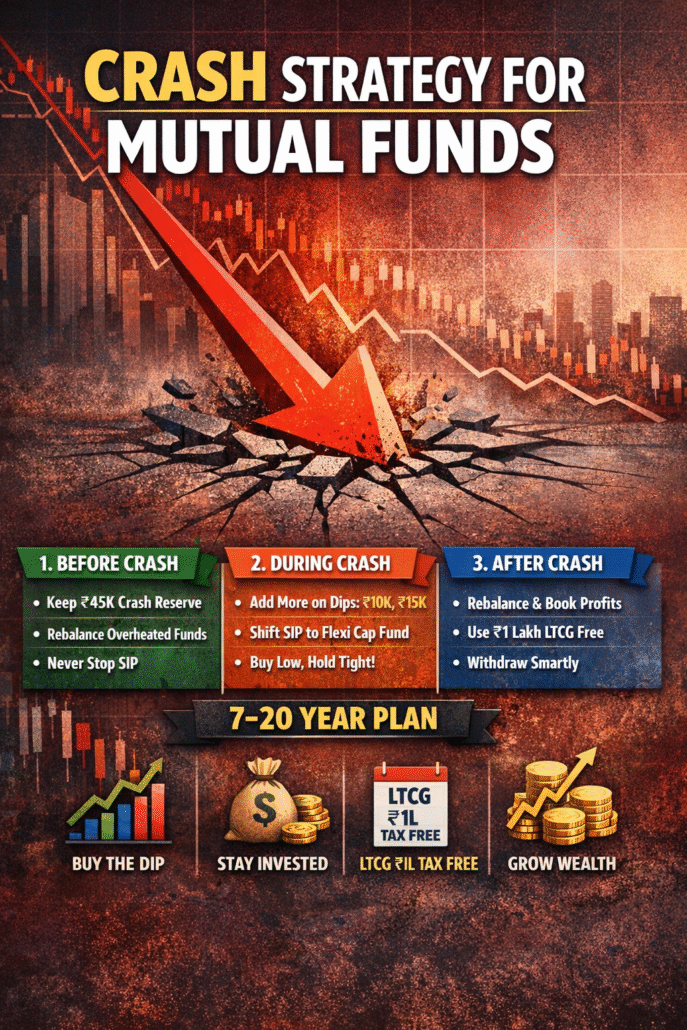
Here is a powerful and practical Crash Strategy built specifically for a high-risk SIP investor like you, investing ₹30,000/month across tech, pharma, mid-cap, small-cap, and infra funds.
This is the same mindset and system seasoned investors use to turn market crashes into wealth-creation opportunities — instead of panic, doubt, or pause.
⚠️ THE CRASH STRATEGY — Step-by-Step Playbook for Market Falls
This is designed for three phases:
1️⃣ Before the Crash
2️⃣ During the Crash
3️⃣ After the Crash
Let’s break it down.
1️⃣ BEFORE THE CRASH — Preparation Phase (The Shield)
Crashes don’t harm prepared investors. They harm confused ones.
✔ Rule 1: Never stop SIP — your SIP is the engine
Stopping SIP during high valuations = okay
Stopping SIP during a crash = biggest mistake
Crash SIP units = highest wealth creators.
✔ Rule 2: Maintain a “Crash Booster Reserve”
Keep 1.5 months of SIP amount aside = ₹45,000
This is NOT emergency fund.
This is ONLY for future crashes.
You will deploy this money when the market falls 10% or more.
✔ Rule 3: Rebalance every 12–18 months
Before a crash, usually one category overheats.
Example: small-caps up 50% in 1 year.
You simply shift 10–15% profit back into flexicap or midcap.
This locks profits before markets turn.
2️⃣ DURING THE CRASH — Execution Phase (The Sword)
This is where wealth is truly built.
✔ Rule 4: Follow the “Crash Add-on Formula”
When market falls 10% → Add one-time ₹10,000
When market falls 20% → Add one-time ₹15,000
When market falls 30% → Add one-time ₹20,000
This money comes from your Crash Booster Reserve.
This is how you buy maximum units at maximum discount.
✔ Rule 5: SIP must continue — strictly
Your ₹30,000 SIP must continue without a single break.
Crashes can last 3–12 months — those months give:
-
Cheapest NAVs
-
Highest future returns
-
Maximum unit accumulation
✔ Rule 6: Shift fresh SIPs temporarily
During deep crashes, do this for 3 months:
Move 20–25% of SIP amount to
👉 Large & Mid Cap OR Flexicap Fund only
Why?
Because flexicap automatically redirects money into undervalued stocks safely.
Once markets stabilise, shift SIP back to original allocation.
3️⃣ AFTER THE CRASH — Harvesting Phase (The Victory)
✔ Rule 7: Don’t expect immediate recovery
Historically:
-
Markets crash in 2–3 months
-
Markets recover in 8–24 months
Wealth is created because you accumulated huge units cheaply.
✔ Rule 8: Rebalance after recovery
When your small-cap or tech fund jumps 40–50% from the bottom:
Shift 10–20% profit back to flexicap.
This locks gains before the next cycle.
✔ Rule 9: Increase SIP by 10% annually
Example:
Year 1 → 30,000
Year 2 → 33,000
Year 3 → 36,300
This keeps you ahead of inflation + wealth cycles.
🔥 THE BIG SECRET: Crashes Make Millionaires
If you simply follow these 3 rules during a crash:
1️⃣ Don’t stop SIP
2️⃣ Buy extra units
3️⃣ Rebalance after recovery
You automatically outperform:
-
90% retail investors
-
80% wealth managers
-
Most of India’s new SIP investors who panic
📌 Want an Even More Powerful Strategy?
Here is a Tax-Efficient Withdrawal Strategy designed specifically for your high-risk, multi-fund SIP portfolio, optimised for 7–15 years of compounding.
This plan ensures:
✔ Minimum capital gains tax
✔ Maximum indexation benefit
✔ Smart sequencing of withdrawals
✔ Protecting small-cap/mid-cap gains
✔ Ensuring you don’t break compounding early
🔥 THE TAX-EFFICIENT WITHDRAWAL FRAMEWORK (Indian Mutual Funds)
This is a 3-layer withdrawal system:
1️⃣ Layer 1 — FIFO + Long-Term Capital Gains optimisation
2️⃣ Layer 2 — Category prioritised withdrawal (least tax first)
3️⃣ Layer 3 — Exit load minimisation + systemised withdrawal schedule
Let’s break it down clearly.
🟩 1️⃣ ALWAYS WITHDRAW FROM THE LOWEST-TAX BUCKET FIRST
Indian MF taxes are simple:
⭐ Equity Funds (Flexicap / Large Cap / Mid / Small / Tech / Pharma)
-
LTCG (>1 year holding) → 12.5% tax above ₹1,25,000 gains
-
STCG (<1 year) → 20% tax
⭐ Debt/Hybrid Funds
-
Taxed as per your slab, no indexation (post 2023 rule).
Since your portfolio is mostly equity-heavy (high risk), you benefit massively by following this order:
🟢 WITHDRAWAL ORDER (MOST TAX EFFICIENT)
1. Withdraw from FLEXICAP first
👉 Parag Parikh Flexicap
Why?
-
Lowest potential future returns → best to withdraw first
-
LTCG only
-
Helps preserve small-cap & tech compounding
2. Withdraw from LARGE & MID / MIDCAP next
👉 Motilal Oswal Midcap Fund
Why?
-
Midcaps have good returns but not as explosive as smallcaps
-
Taking money here reduces volatility later in life
-
Already LTCG after 1 year
3. Withdraw from TECHNOLOGY & PHARMA next
👉 Invesco India Technology Fund
👉 ICICI Pru Pharma Fund
Why?
-
These sectors move in cycles
-
Harvesting after big gains reduces massive future taxes
-
They tend to give 7–10yr bursts
4. Withdraw from SMALL CAP LAST
👉 Quant Small Cap Fund
Why?
-
Smallcap delivers maximum compounding if untouched
-
Selling early destroys 80% wealth potential
-
ALWAYS withdraw small-cap LAST because:
-
highest expected long-term CAGR
-
selling small-caps early is the biggest mistake SIP investors make
-
🟨 2️⃣ USE THE “1.25 LAKH TAX-FREE GAIN RULE” EVERY YEAR
Government gives you ₹1,25,000 LTCG per financial year TAX-FREE.
This is gold.
⭐ Strategy:
Start a Systematic Withdrawal Plan (SWP) of ₹8,000–₹10,000/month from your oldest units (FIFO), ensuring yearly capital gains stay under ₹1,25,000.
This means:
✔ You withdraw
👉 ₹1.2 lakh tax-free every year,
AND
👉 Your remaining portfolio continues compounding untouched.
This is the cleanest tax-free income source in India.
🟫 3️⃣ STAGGER LUMPSUM WITHDRAWALS TO REDUCE TAX IMPACT
If you want to withdraw a large amount (e.g., ₹10–20 lakh):
Don’t redeem in 1 year.
Spread it across 2–3 financial years so you use the ₹1.25 lakh LTCG exemption each year.
This can save you ₹60,000–₹90,000 in taxes easily.
🔵 4️⃣ SEQUENCE YOUR WITHDRAWALS USING “FIFO ADVANTAGE”
When selling units, India uses FIFO (First In, First Out).
This is amazing for SIP investors.
Most of your early SIP units (older than 1 year) will be LTCG.
All short-term units automatically become LTCG if you wait a bit.
⭐ TIP:
Always check your fund holding age before redeeming.
If units are 11 months old → wait 1–2 months → save 20% STCG tax.
🟣 5️⃣ AVOID EXIT LOAD TRAPS (VERY IMPORTANT)
Most equity funds charge:
-
1% exit load for redemption before 12 months
-
After 1 year → Zero exit load
So:
✔ Always redeem units older than 12 months
✔ Never sell recent SIP units unnecessarily
This alone saves you thousands for free.
🔥 SPECIAL BONUS STRATEGY
🟩 “Harvest & Reinvest” Technique for Zero Tax
Every year:
-
Redeem units worth ₹1 lakh gains
-
Immediately reinvest them in the same fund
Result:
-
Gains become tax-free
-
Unit age resets
-
You lock-in profits
-
But remain invested fully
This is used by many HNIs to reduce lifetime taxes drastically.
🎯 SAMPLE WITHDRAWAL MAP FOR YOUR ₹30,000 SIP PORTFOLIO
When you start withdrawing (say in year 7):
| Priority | Fund | Withdrawal Plan |
|---|---|---|
| 1 | Parag Parikh Flexicap | Full SWP / year 7–10 |
| 2 | Motilal Oswal Midcap | Partial SWP / year 8–12 |
| 3 | ICICI Pharma / Invesco Tech | Partial SWP / year 9–13 |
| 4 | Quant Smallcap | Withdraw ONLY in year 12+ |
This lets your highest-growth funds grow longest.
📆 Year-Wise Withdrawal & SWP Plan (Year 7 to Year 20)
Assume you begin withdrawals in Year 7 (i.e. after ~6 years of SIP + compounding) and continue till Year 20.
| Year | Intended Action / Withdrawal Strategy | Focus / Rationale |
|---|---|---|
| Year 7 | ✔ Start with a small SWP or lump-sum withdrawal from FlexiCap fund (or partially from large/mid-cap portion) — amounts such that estimated LTCG ≤ ₹1.25 lakh. ✔ Do not touch Small-Cap / Tech / Pharma yet. |
Using FlexiCap first preserves high-growth portions; LTCG exemption utilised. |
| Year 8 | Continue SWP from FlexiCap + begin small withdrawals from Mid-Cap fund (if mid-cap portion has matured > 1 year). Keep total expected LTCG ≤ ₹1.25 lakh per financial year. | Diversifies withdrawal sources; reduces equity-concentration gradually. |
| Year 9 | Partial withdrawal from Large/Mid-cap + Mid-Cap funds; possibly small withdrawal from Technology or Pharma funds if NAV/gains have appreciated. Avoid touching Small-Cap. | Harvest moderate gains from relatively stable segments; maintain high-growth base intact. |
| Year 10 | Moderate redemption from FlexiCap + Mid-Cap + part of Tech/Pharma, if needed. Continue skipping Small-Cap. Optionally, increase SWP amount if needed. | Balances between liquidity needs and long-term growth. |
| Year 11 | Begin careful withdrawals from Small-Cap fund — but only a small part, if absolutely needed. Prefer staying invested if possible. | By now small-cap holdings have matured — but early redemption reduces compounding benefit. |
| Year 12 | If past 3 years withdrawals were modest, consider incremental increase in SWP (e.g. 5–10% higher), taken partly from Mid-Cap, Tech/Pharma, and maybe a small bit from Small-Cap. | Gradual ramp-up in income while keeping core growth intact. |
| Year 13–14 | Continue systematic withdrawals — mainly from FlexiCap, Mid-Cap, Tech/Pharma; withdraw from Small-Cap only as needed. Keep an eye that annual LTCG stays within exemption band; if gains are high, consider pausing or reducing withdrawal. | This preserves tax efficiency and allows compounding for remaining corpus. |
| Year 15 | Review portfolio value, goals, and required cash flows. Consider rebalancing: shift a portion of Small-Cap or mid-cap profits into safer or hybrid funds if risk tolerance has dropped. Begin partial redemptions if you need larger cash outflows (e.g. children, property, retirement). | Transition toward more stable portfolio if nearing long-term goals. |
| Year 16–17 | Continue withdrawals as needed. If corpus large and growing, you may withdraw slightly more; still aim to keep LTCG per FY under ₹1.25 lakh if possible — or withdraw in lumps spaced across two financial years to minimise tax. | Avoid heavy tax burden; maintain compounding benefits for remaining amount. |
| Year 18 | Likely you have built a substantial corpus. Consider shifting a portion to safer funds or hybrid funds for capital preservation. Continue withdrawals — mix of SWP + periodic lump-sum redemptions. | Protect gains against volatility; stable income / capital preservation becomes priority. |
| Year 19 | Evaluate long-term cash needs. If retirement/financial goal is near, reduce exposure to high-risk funds (small-cap / tech). Withdraw remaining portion gradually using SWP, ideally keeping LTCG within exemption limit. | Smooth transition from growth to stable income/ corpus. |
| Year 20 | Full withdrawal if required — but ideally, maintain a core residual portfolio (some portion in balanced/flexicap or conservative funds) for contingency or legacy. Withdraw via SWP or lumpsum (spread to manage LTCG tax). | Preserves some compounding benefit, avoids lump-sum shock or heavy tax. |
🎯 Customization Based on Your Life / Cash Needs
This blueprint assumes moderate cash needs — you withdraw only as needed, not everything at once.
If your needs rise (children’s education, property, emergencies), you can adapt: withdraw more from FlexiCap or Mid-Cap early, keep Small-Cap intact.
If you want higher inflation-adjusted income after Year 10, gradually increase SWP by 5–10% every 2 years — but watch LTCG gains.


